
WorkLong Life Wall Coating · client
Simple was the brief. Making sure simple worked was the job.
A paying client asked for a simple website on a small budget. The job was making sure simple still worked, and then checking my own work against the live site before writing a word of this page.
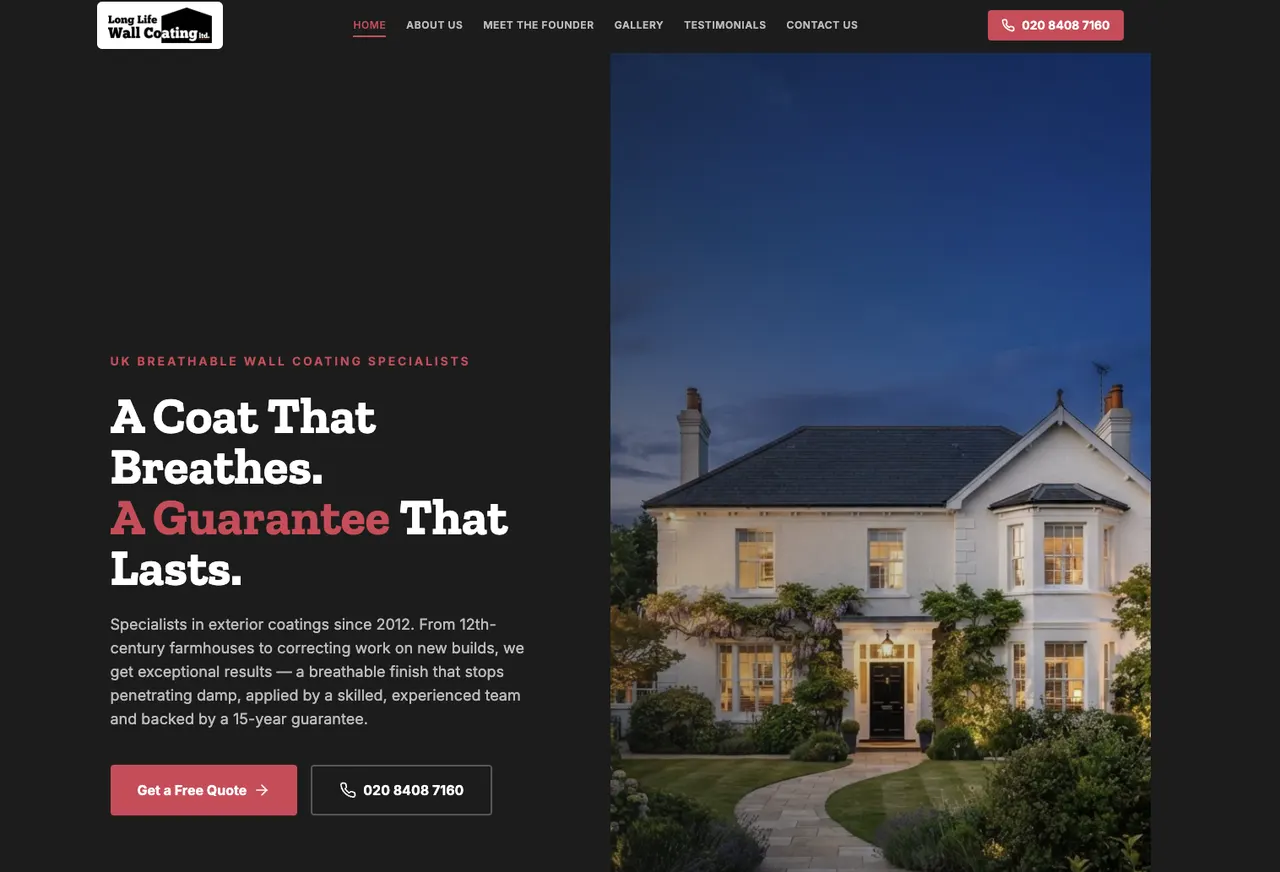
Long Life Wall Coating Ltd is a client, not a business I own. This was a paid engagement. Luke Whitehouse, the founder, agreed to being named and linked on this page, and has said he is happy to speak to anyone thinking of working with me. Ask and I will put you in touch.
01The business
Long Life Wall Coating applies breathable external wall coatings. It is a trades business that wins work by being found and then contacted.
The site is at longlifewallcoating.co.uk. Everything this page says about it can be checked there.
02The challenge
Long Life Wall Coating had a website that had been down for some time before Luke called me. Not slow, not dated: unreachable. For a business that wins work by being found and then contacted, that is not a marketing problem, it is a closed front door.
It went down because nobody was maintaining it. The site ran on a content management system, and a system nobody manages is not a safety net. That detail matters more than the platform's name, which is why the platform is not named here.
Luke was clear from the first conversation about two things: he wanted it simple, and the budget was small. He set that scope, not me. My job was to make sure simple still worked.
03What I built
What the site needed to be. In Luke's own words, a window to connect with the business: a contact route, contact details, and examples of the work. That is the whole brief, and it is a good one.
I wrote the copy from material Luke supplied. The part I would point you to is a section called Our Record, which publishes the company's own incident history: overspray, minor plant damage, one damaged roof tile, and what was done about each. Most trades would not print that. It is the most persuasive thing on the site, because a firm that shows you its defect list is telling you how it will behave when something goes wrong on your wall.
What Luke asked me to leave out. Four things, all at his wish:
- No content management system
- No blog, news or case study library
- No multi-page service structure
- No bookings, payments or accounts
I agreed with all four, and with the first for a reason worth stating plainly. The old site had a content management system, and it still went dark. Nobody at an exterior coatings firm is a webmaster, and nobody should have to be. Software that lets you edit a site does not keep it running. Somebody looking after it does.
There is a trade in that, and Luke knows it: changes to the site now come through me. That is a real dependency and the honest cost of the decision, so it is written here rather than left for you to spot.
04How I did it
What simple could not skip. A small budget decides how much gets built. It does not decide whether what is built works. Three things were never going to be cut, and all three were in place on the live site by 25 September:
- The enquiry route is proven, not assumed. Every enquiry is saved before anything is sent, delivered with a tracking reference, and falls back to a second mail route if the first refuses. A test enquiry on 25 September was confirmed received by the client. A contact form that quietly fails is the same closed door as before, just better looking.
- Privacy and the legal basics. A privacy and cookies notice and terms of use, linked from every page, with a plain line beside the submit button saying what the details are used for.
- It works on a phone, tested at a real mobile size rather than by shrinking a desktop window.
What checking my own work found. Before writing this page I checked every claim on it against the live site, rather than against my memory of building it. Two of those three were not yet true on the public site: there was no privacy notice, and the enquiry route had been built but never shown to deliver. Search engines were also being offered four login pages that do not exist on a site with no logins.
I spotted it, so I fixed it. The fixes were built on 14 September, held in staging, and went live together on 25 September. There was never a question of leaving them, or of charging Luke for work that should have been right the first time. That is what the standard is for, and it applies to my own work before anyone else's. This page waited until they were live.
None of it is visible to the person paying, and none of it is something a client knows to ask for. That is the reason to check.
05The result
The site went live on 22 August, and the business is contactable again. The fixes above went live on 25 September.
I am not putting a revenue or enquiry figure on this page. I do not have one I could defend in three years, and a number I cannot stand behind is worth less than no number at all.
What I can tell you is what the engagement did and did not include, which is the part most likely to help if you are weighing up a small build. The scope was set by the client, the price matched it, and the parts that decide whether a site actually works were not the parts that got cut.
06Questions worth asking about your own business
- If your website went down tomorrow, who would notice first, and how long would it take them?
- When did someone last send a test enquiry through your site and confirm it arrived?
- Does your contact form tell people what happens to their details before they press send?
- Who looks after your website, by name?
Start with the diagnostic, or just ask.
Four questions, about a minute, no email needed. If you would rather talk, the first call is free.
I reply within 2 business days.